Neon Vaporwave Runner
Reviews
Neon Vaporwave Runner keeps its scope narrow: one jump input, procedurally arranged obstacles, coins for score, and a pace that climbs the longer you survive. That simplicity makes it easy to start but hard to master, since every run demands fresh timing rather than memorized routes. The neon vaporwave aesthetic gives it a clear visual identity among endless runners. Its main limitation is depth; players seeking varied mechanics or structured levels will find a single, repeating loop. It best suits those who enjoy reflex-driven score chasing in short browser sessions.
Description
Endless Running in a Neon World
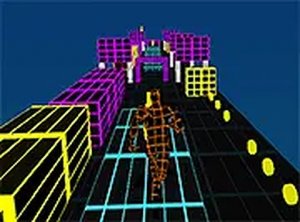
Neon Vaporwave Runner drops players into a bright, retro-futuristic setting where the only goal is distance. The environment generates continuously, so the arrangement of obstacles and platforms differs on every attempt. A run ends when the character collides with an obstacle, making survival the primary measure of success. Because the layout is never fixed, players cannot memorize a single route; they must read each new sequence as it appears.
Jumping, Coins, and Escalating Speed
Control is limited to a jump action, triggered by the spacebar or a mouse click. That single input must be timed against ground-level barriers and gaps between platforms. Coins sit along the path and add to the score when collected, but grabbing them often means jumping at a moment that leaves less room for error. As a run continues, the game accelerates, shortening the window for every decision. The result is a steady pressure curve: early seconds feel manageable, while later sections demand sharper focus and quicker coordination.
Visual Style and Browser Access
The vaporwave presentation is central to the game's identity. Saturated neon colors and a retro-futuristic palette distinguish it from the plain look of many endless runners. A full-screen mode is available for desktop browsers, which reduces surrounding distractions and enlarges the play area. No installation or download is needed; the game runs directly in a browser, so a session can start immediately. That low-friction setup suits short breaks as well as repeated attempts aimed at beating a previous distance.
What a Run Actually Asks of You
Success depends on timing, not complex inputs. Players who anticipate obstacle patterns tend to make smoother jumps, while those who react late often clip a barrier. Coins create a small risk-reward decision: chasing them can raise the score, but a risky grab can end a promising run. The difficulty comes from the speed increase rather than from new mechanics, so improvement is mostly a matter of practice and concentration. Each failure provides information about spacing and rhythm that carries into the next attempt.










Editorial Notes