Merge Number Puzzle 2048

Reviews
Merge Number Puzzle 2048 stands out from standard 2048 clones by adding a circular arena and a fatal outer boundary. That single rule changes how you think about placement, turning every drop into a spatial puzzle. The absence of timers makes it accessible for children and casual players, while chain merges offer enough depth for puzzle fans. The cheerful visuals and smooth animations support the relaxed tone. The main limitation is that the core loop remains familiar, so veterans of the genre may find the challenge comes mostly from the boundary constraint rather than new mechanics.
Description
Merging Tiles in a Bounded Arena
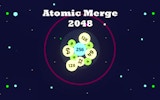
Merge Number Puzzle 2048 takes the familiar 2048 formula and places it inside a circular arena with a strict spatial rule. You tap or click to drop numbered blocks, and when two tiles with the same value touch, they combine into a single tile of double the value. The immediate goal is to keep merging to create higher numbers, with 2048 as the iconic target. Unlike sliding-block versions, this game asks you to think about vertical stacking and the available floor space. The outer orbit boundary is not just decoration; if any part of your stack touches it, the game ends. That constraint forces you to manage the arena's edges as carefully as the center.
No Timers, Just Tactics
There is no countdown clock or move limit, so you can study the board before every drop. That calm pace makes the game suitable for short breaks or longer sessions, and it shifts the challenge entirely to planning. The main decision each turn is where to place the next block so that it either sets up a future merge or avoids crowding the boundary. Because merges free up space, a well-placed tile can trigger a chain reaction where several pairs combine in sequence. Those chain merges are the most efficient way to raise your score and unlock advanced tiles. The game's difficulty comes from anticipating how the stack will grow and where gaps will appear.
Visuals and Family-Friendly Design
The presentation uses cheerful colors and smooth animations that make each merge feel satisfying without being distracting. The interface is simple enough for children to understand, and the content contains nothing inappropriate, so unsupervised play is an option. This is a brain teaser built around number recognition and pattern spotting rather than reflexes. Players who enjoy logic puzzles or want a low-pressure way to pass time will find the loop easy to learn but surprisingly deep once they start planning several moves ahead.


Editorial Notes