Aerial Dash Pilot
Reviews
Aerial Dash Pilot keeps its scope tight: one automatic jetpack, left and right steering, and an endless stream of barriers. The neon skyline gives obstacles clear silhouettes, which matters when speed rises. Procedural layouts and distance-based scoring support repeated attempts. The limitation is variety: with no vertical movement and no stated modes beyond score chasing, players who want deeper mechanics may find it thin.
Description
Jetpack Steering and Immediate Feedback
In Aerial Dash Pilot, the character stays airborne without any input. The only control is horizontal movement: tap or press left or right to shift position. That simplicity puts all the pressure on timing. Obstacles enter the path, and the jetpack's automatic lift means you cannot climb or drop to escape. Every decision is about where you are when a barrier arrives. The controls respond quickly, so mistakes usually come from reading the pattern too late rather than from fighting the input.
Reading Obstacle Patterns
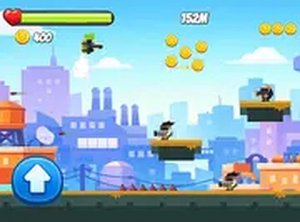
Barriers vary. Some hold a fixed position; others move in predictable loops. Because the jetpack never stops, you cannot pause to study a layout. You either commit to a gap or drift toward a safer lane. Moving obstacles punish hesitation as much as recklessness: slowing down to line up a passage can leave you in the wrong spot when a moving barrier crosses. The game rewards players who recognize a pattern early and adjust position before the gap closes. [IMG_1]
Neon Skyline and Visual Clarity
The setting is a futuristic skyline with glowing neon colors and smooth animation. Towers and distant city structures scroll past as you advance. The bright backdrop is not just decorative; obstacles stand out as clear silhouettes against it, so you can track hazards without visual clutter. That contrast helps at higher speeds, when reaction time shrinks and a single missed shape ends the run.
Procedural Runs and Score Chasing
Each attempt uses a procedurally generated obstacle layout, so no two runs follow the same sequence. The game tracks distance traveled and awards points for surviving longer and collecting floating items along the way. Speed increases as the run continues, which raises the demand on reflexes and anticipation. Because sessions are short and the difficulty curve keeps climbing, the main long-term goal is beating your own best distance rather than reaching a final level. [IMG_2]









Editorial Notes