Isometric Block Puzzle
Reviews
Isometric Block Puzzle stands out by making group movement the core mechanic rather than an occasional shortcut. The absence of timers and move limits keeps the experience relaxed, while later levels add complexity through tighter arrangements and larger block clusters. The minimalist isometric presentation keeps layouts readable. It suits players who enjoy spatial reasoning and prefer thoughtful pacing over speed. The main limitation is that the concept stays within one mechanic, so variety depends on level design rather than new features.
Description
What You Actually Do
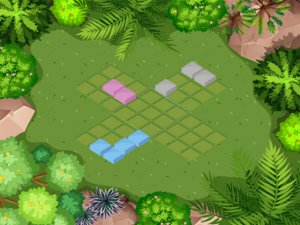
Every level in Isometric Block Puzzle presents a scattered arrangement of blocks on an isometric grid. Your single objective is to fit all of them into the center to create a complete square. You do this by clicking a block or a connected group of blocks, which scrolls that selection toward the middle of the screen. The game begins with simple layouts, but later stages introduce tighter spaces and more complex block clusters that demand careful planning.
Why Grouping Changes Everything
The defining mechanic is that you can move multiple blocks at once, not just individual pieces. Selecting a group and sliding it together is often the only efficient way to solve a level. This twist separates the game from traditional sliding puzzles, where single-tile moves are the norm. Thinking in groups rather than isolated blocks becomes essential as difficulty rises, and it directly affects how quickly you can clear space near the center.
Pacing and Presentation
There are no timers, move limits, or penalties for taking your time. The clean, minimalist isometric design reduces visual clutter, so the block arrangement stays readable even on busier levels. That combination makes the game suitable for short breaks or longer sessions without pressure. Each new level offers a fresh block layout, which encourages creative problem-solving instead of memorizing a fixed sequence.
Approaches That Tend to Work
Start by identifying the largest movable groups and scroll them toward the center first. This clears space and prevents smaller blocks from getting trapped against the edges. Plan a few clicks ahead so you do not block the central area prematurely. If a layout feels stuck, changing the order in which you move groups often reveals a solution. Regular play gradually sharpens spatial reasoning and pattern recognition.










Editorial Notes